Choosing the framing material for a bespoke conservatory defines both the architectural character of the space and its performance over decades in the British climate. While uPVC dominates the volume market and hardwood timber remains a traditional favourite, architectural steel and wrought iron occupy a distinct tier for homeowners and architects seeking slim sightlines, structural permanence, and intricate detailing.
1. Sightlines and Natural Light Transmission
The defining advantage of steel over both timber and uPVC lies in its strength-to-weight ratio:
- Steel & Wrought Iron: Because steel is inherently rigid, structural mullions and roof rafters can be engineered with remarkably narrow profiles. This maximises the glass-to-frame ratio, flooding adjoining interior rooms with natural daylight.
- Timber: Hardwood requires substantial cross-sectional thickness to support heavy double-glazed roof units over wide spans, resulting in heavier visual framing.
- uPVC: Bulky welded chambers and thick reinforcement sleeves create wide sightlines that often appear disproportionate on period or architect-designed homes.
2. Structural Span and Geometric Freedom
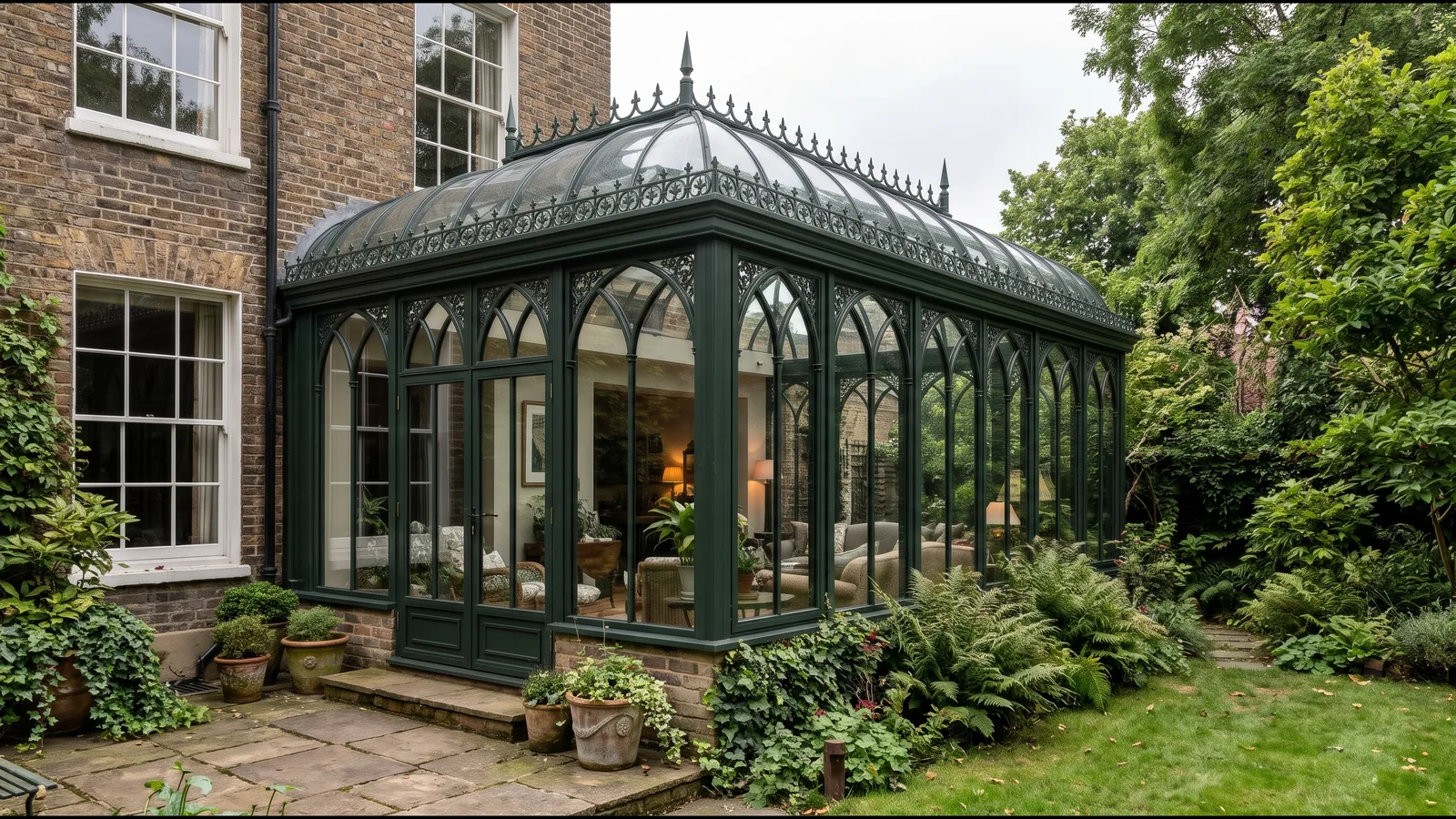
Complex architectural forms—such as barrel-vaulted roofs, gothic pointed arches, and multi-faceted octagonal pavilions—place significant lateral and snow loads on the supporting frame. Steel accommodates sweeping curves, custom crestings, and expansive unobstructed spans without requiring intrusive internal tie-bars or oversized corner posts.
3. Maintenance and Durability in the UK Climate
Britain’s combination of persistent dampness, wind-driven rain, and freeze-thaw cycles tests exterior joinery relentlessly:
- Timber: Even high-grade hardwoods like oak or sapele expand and contract with seasonal moisture shifts. Joints require periodic repainting or re-staining every few years to prevent water ingress and timber rot.
- uPVC: Resistant to rot, yet prone to thermal expansion, seal degradation, and discolouration over time, with limited repairability once frames warp.
- Protected Architectural Steel: Properly prepared and coated steel frames resist warping, cracking, and rot. With modern anti-corrosion surface treatments and durable architectural powder coatings, maintenance is largely limited to routine glass cleaning and hardware checks.
4. Long-Term Property Value
In prime residential markets across London and the Home Counties, buyers distinguish sharply between temporary add-ons and permanent architectural extensions. A bespoke steel conservatory acts as a structural asset that elevates the architectural pedigree of the property, whereas standard uPVC structures often require replacement by subsequent owners.
How the three materials compare at a glance
A fair comparison looks beyond the purchase price. The table below summarises how each frame material behaves in a bespoke conservatory over its working life.
| Steel | Hardwood timber | uPVC | |
|---|---|---|---|
| Typical sightline | Slimmest | Wider | Widest |
| Curves and arches | Rolled to radius | Laminated, costly | Very limited |
| Ornament | Cast, forged or laser-cut | Carved, applied | Mostly clip-on |
| Routine maintenance | Low once coated | Regular redecoration | Low, limited repair |
| Colour | Any RAL colour | Paint or stain | Limited range |
Why sightlines change how a room feels
A conservatory is mostly glass, but the frame decides how that glass is read. With a slim steel frame, the glazing bars become a fine drawn grid in front of the garden, and the room feels like part of the landscape. Wider timber or uPVC sections cast heavier shadows and break the view into smaller pieces. The effect is most obvious in roofs, where rafters that are too deep make a ceiling feel lower than it is.
Our Green Crescent gallery runs to about 23 metres in length with twelve repeated bays. In timber, the same rhythm would need deeper posts and heavier eaves beams; in steel, the bays stay narrow and the tall arched lights carry the eye along the curve.
Thermal performance is a question of detailing
Metal conducts heat, so an uninsulated steel frame would lose warmth and attract condensation. Modern conservatory steel avoids this with a thermal break between the inner and outer faces, insulated glazing units, warm-edge spacers and carefully sealed junctions. Timber is naturally less conductive, but a timber roof with poor seals or single glazing will still be cold. In practice, the glazing specification, ventilation and heating have more effect on comfort than the frame material alone. Our guide to condensation and heat loss explains the details.
Maintenance over thirty years
Hardwood needs regular redecoration to stay sound, especially on south and west elevations and on horizontal surfaces such as sills and glazing beads where water collects. uPVC needs little upkeep, but discoloured or distorted sections are hard to repair and are usually replaced. Steel, once properly prepared and coated, mainly needs cleaning, checks on seals and drainage paths, and touching up of any chips in the coating before they spread. Specifying the coating system correctly at the start, with attention to cut edges and fixings, matters more than any later maintenance.
Cost and value
A bespoke steel conservatory usually costs more than a uPVC structure of the same footprint and is broadly comparable with high-end hardwood once ornament, curves and site work are included. The difference shows over time and at resale: a well-detailed steel structure reads as a permanent part of the architecture of the house rather than an addition that a future owner will want to replace. For a breakdown of the cost drivers, see our London cost guide.
Which material suits which house
- Victorian and Edwardian terraces: slim steel with heritage colours suits the scale of the openings and the brickwork.
- Georgian houses and listed buildings: steel or carefully detailed timber, chosen with the conservation officer.
- Country houses and large gardens: steel for long spans, curved roofs and freestanding pavilions.
- Modern homes: slim dark steel for a crisp, minimal grid.
Frequently asked questions
Are steel conservatories cold in the winter?
Modern architectural steel systems incorporate thermal break technology and high-specification insulated glazing units, preventing cold bridging and allowing comfortable year-round use when paired with appropriate heating.
Can steel frames be finished in heritage colours?
Yes. Bespoke metal frameworks can be finished in a wide spectrum of matte, satin, or textured RAL colours—including classic heritage greens, deep anthracite, and dark bronze—to match existing window joinery.
How does the lifespan of a steel conservatory compare to hardwood?
With proper corrosion protection and powder coating, a steel-framed conservatory can last for many decades without warping or rot, whereas timber joinery typically demands intensive cyclical repainting every 5 to 7 years.
Is steel suitable for curved or barrel-vaulted glass roofs?
Yes. Steel profiles can be precision-rolled to smooth architectural radii, making them ideal for Victorian curved eaves and barrel-vaulted roof designs.