
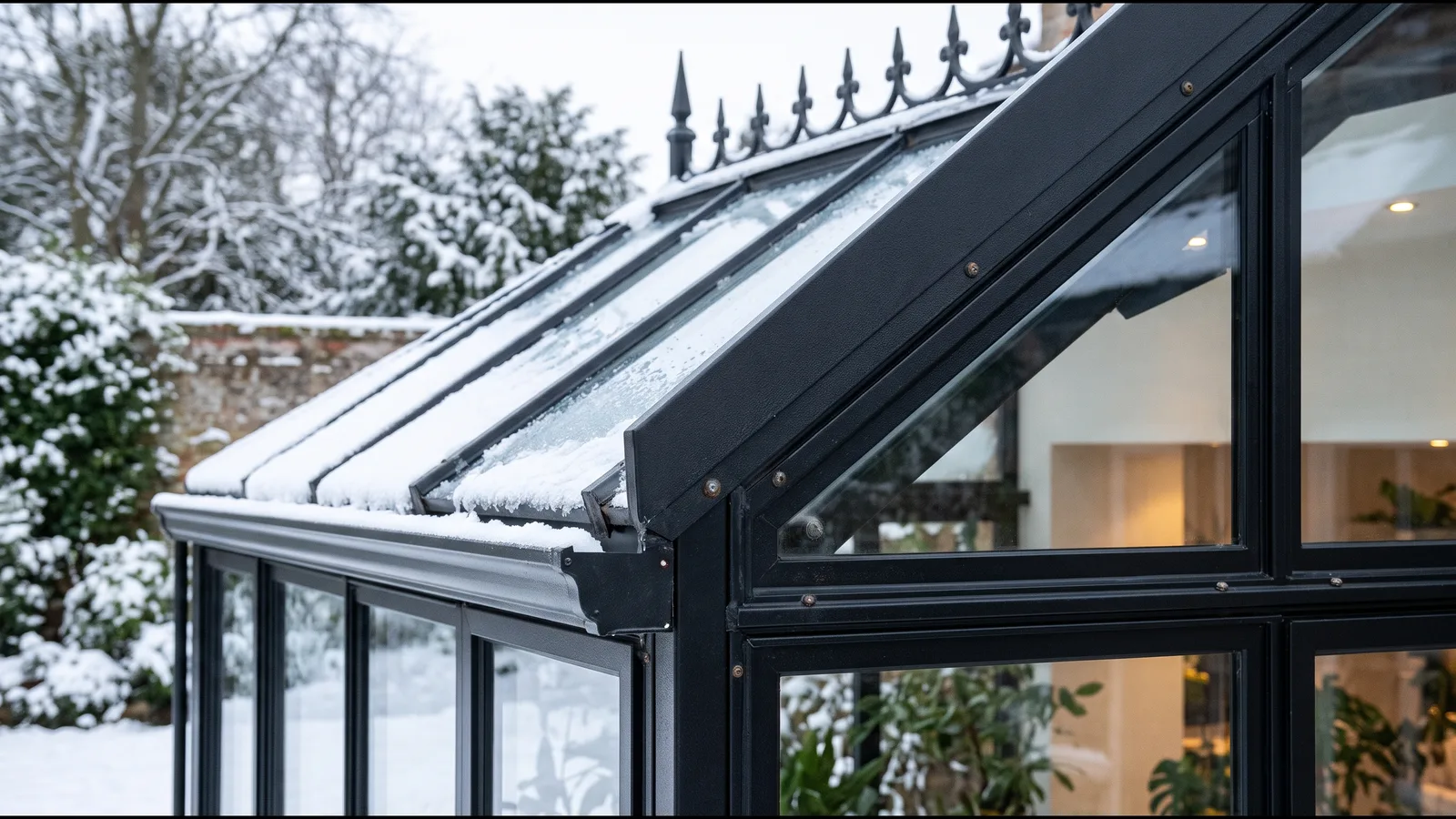
The most common concern homeowners raise when considering a metal-framed conservatory is thermal performance: Will the frame feel cold in winter, and will condensation form on the glass and steel? While historic 19th-century single-glazed iron glasshouses suffered from severe heat loss, modern architectural engineering has transformed metal conservatories into comfortable four-season living spaces.
1. Thermal Break Technology
Solid metal conducts heat rapidly. To prevent cold exterior temperatures from transferring through the frame to the warm interior air, modern insulated steel and metal systems incorporate a thermal break—a continuous, low-conductivity polyamide or composite barrier positioned between the inner and outer metal profiles. This raises the internal surface temperature of the frame and eliminates cold bridging.
2. High-Specification Double and Triple Glazing
Because glass accounts for over 80% of a conservatory’s surface area, glazing specification governs comfort:
- Low-Emissivity (Low-E) Coatings: Microscopic metallic coatings reflect indoor radiant heat back into the room while allowing natural daylight through.
- Argon Gas-Filled Cavities & Warm-Edge Spacer Bars: Slowing convective heat transfer across the cavity and preventing cold perimeter edges where condensation typically starts.
- Solar Control Glazing: Essential for glass roofs to reflect excess infrared solar radiation in July and August without tinting the glass dark.
3. Ventilation and Heating Integration
Controlling indoor humidity is just as important as insulation. Pairing discreet trickle vents and automated ridge openers with perimeter trench heaters or wet underfloor heating keeps warm air circulating across the glass surface, preventing dew-point condensation even during freezing winter weather.
Why condensation forms
Air holds moisture as vapour. When warm, moist air meets a surface below its dew point, the vapour condenses into droplets. In a conservatory the coldest surfaces are usually the glass edges, the frame and any metal that bridges from outside to inside. Cooking, people, plants and drying laundry all add moisture to the air. Condensation appears when those surfaces are cold and the moisture has nowhere to go.
The four ways to control it
- Keep the inner surfaces warm: thermally broken frames, insulated glazing with low-emissivity coatings and warm-edge spacers raise the temperature of the inner face.
- Remove moisture: trickle vents, openable roof vents and, in larger rooms, mechanical ventilation with heat recovery.
- Keep air moving: heating along the glazed perimeter, such as trench heaters below doors, washes the cold glass with warm air.
- Manage sources: avoid drying laundry in the room and allow for the moisture from large plant collections.
Glazing in more detail
The centre-pane U-value of a glazing unit measures how much heat passes through it. Modern double glazing with a low-emissivity coating and argon fill performs far better than older units, and triple glazing improves on that again, though at the cost of extra weight that slim frames must carry. The edge of the unit is often the weak point: a metal spacer bar conducts heat and makes the outer few centimetres of the glass much colder than the centre. Warm-edge spacers made from plastic or composite reduce that effect and are among the most cost-effective ways to limit condensation at the frame.
Roof glazing faces the open sky, which radiates heat away at night. On clear winter nights roof glass can become colder than wall glazing, so the roof specification deserves particular attention.
Frames and junctions
A thermal break separates the inner and outer metal of the frame with a low-conductivity material. It works only if it runs continuously: a fixing bolt or a steel bracket that passes straight through can create a cold spot. Good detailing keeps structural connections on the warm side or uses isolating pads. The same care applies at the base, where the frame meets the dwarf wall or slab, and at the abutment with the house.
Heating strategies
- Underfloor heating: even and invisible, ideal as background heat, slower to respond.
- Trench heaters: fitted in the floor along glazed walls and doors, they counter cold downdraughts and condensation.
- Air-source heat pumps: efficient for heating, and many can also cool in summer.
- Controls: a separate thermostat for the conservatory is required where it is thermally separated from the house to stay exempt from Building Regulations.
Historic precedent
Victorian glasshouses dealt with condensation by accepting it: single glazing ran with water, and gutters at the base of the glazing bars carried it away. Our article on how nineteenth-century ironwork became modern slim steel explains how today's systems keep those slender profiles while solving the thermal problem. For regulatory requirements, see our Building Regulations guide.
Frequently asked questions
Why does condensation form on older conservatories?
Condensation occurs when warm, moisture-laden indoor air meets a cold surface below its dew point—most commonly caused by single glazing, uninsulated metal frames, or stagnant air circulation.
Is underfloor heating enough to heat a metal conservatory in winter?
In well-insulated double-glazed conservatories, hydronic or electric underfloor heating provides even radiant warmth, though projects with high vaulted ceilings may benefit from supplementary perimeter trench convectors.
Does solar-control glass make the conservatory dark on cloudy UK days?
No. Modern spectrally selective solar-control coatings achieve high visible light transmittance while filtering out unwanted solar heat gain.
Do heritage glazing bars compromise thermal performance?
When applied as duplex or external/internal architectural bars over a continuous sealed double-glazed unit, traditional glazing grids preserve the full thermal integrity of the glass pane.